Blog
Agriculture Insurance in Bangladesh: A Comprehensive Guide to Risk Management and Legal Frameworks
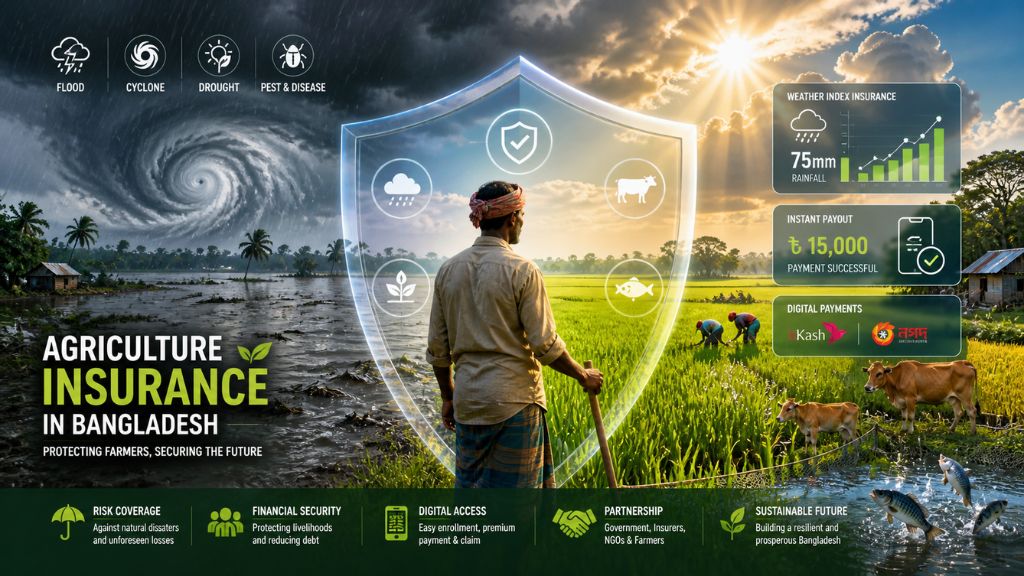
Agriculture is the heartbeat of Bangladesh’s economy, contributing significantly to the GDP and employing nearly half of the workforce. However, Bangladesh is also one of the most climate-vulnerable nations in the world. For a farmer, a single season of excessive rainfall, a sudden cyclone, or a prolonged drought can mean the difference between financial stability and devastating debt
Despite its importance, Agriculture Insurance (Agri-Insurance) remains a misunderstood and underutilized tool in our country. This article provides an in-depth look at how agriculture insurance works in Bangladesh, the laws governing it, and the challenges and opportunities for the future.
1. The Necessity of Agriculture Insurance in Bangladesh
In Bangladesh, agriculture is an "outdoor factory" without a roof. Unlike traditional sectors where risks can be controlled, farming is entirely dependent on nature.
Why Farmers Need Insurance:
- Climate Vulnerability: Frequent floods, cyclones, and salinity intrusion in coastal areas.
- Pest and Disease Outbreaks: Unpredictable attacks on crops and livestock.
- Price Volatility: Sudden drops in market prices during harvest seasons.
- Debt Traps: Most smallholder farmers rely on seasonal loans. Without insurance, a crop failure leads to a permanent cycle of high-interest debt.
2. Understanding the Legal Framework: The Insurance Act 2010
The modern landscape of agriculture insurance is shaped by the Insurance Act of 2010 and the oversight of the Insurance Development and Regulatory Authority (IDRA).
Key Legal Provisions:
- Micro-Insurance Inclusion: The Act recognizes the need for micro-insurance, which is essential for reaching rural smallholder farmers who cannot afford high premiums.
- The Role of Intermediaries: Unlike car insurance in Bangladesh, where the relationship is usually between the owner and the company, the law allows NGOs and Microfinance Institutions (MFIs) to act as vital bridges to deliver agri-insurance to the doorstep of the farmer.
- Mandatory vs. Voluntary: While certain types of commercial insurance are mandatory, agriculture insurance in Bangladesh is currently largely voluntary or tied to agricultural credit (bank loans).
3. Types of Agriculture Insurance Models in Bangladesh
According to World Bank research, traditional "Indemnity-Based Insurance" (where an agent visits the field to calculate actual loss) is difficult to implement in Bangladesh due to the millions of small, fragmented landholdings. Instead, modern models are being tested:
A. Weather Index-Based Insurance (WIBI)
This is the most promising model for Bangladesh. Instead of measuring actual crop loss, the payout is triggered by weather data.
- Example: If a weather station records rainfall below a specific millimeter threshold during the monsoon, all insured farmers in that zone get an automatic payout.
- Benefit: No need for physical inspections, making it faster and cheaper.
B. Area-Yield Index Insurance
In this model, the average yield of an entire Upazila or District is calculated. If the total output falls below the historical average (due to a natural disaster), the insurance covers the gap for all participating farmers.
C. Livestock and Poultry Insurance
Livestock is often a farmer's most valuable asset. Policies typically cover:
- Death due to accidents or natural calamities.
- Specified diseases (like Foot and Mouth Disease).
- Theft or permanent disability of the animal.
D. Aquaculture Insurance
With Bangladesh being a global leader in fish production, insurance for shrimp and fish farms is emerging, though it remains complex due to the difficulty of monitoring underwater stock.
4. The Difference: Agriculture vs. Non-Life Insurance
It is important to distinguish agriculture insurance from other common types of "Non-Life" insurance.
While products like truck insurance or bike insurance in Bangladesh rely on clear, individual incident reports (like an accident or theft), agriculture insurance deals with systemic risk. Systemic risk means that when a disaster happens, it usually affects everyone in the region at once. This makes agriculture insurance much more complex for companies to manage without government support or international reinsurance.
5. Major Challenges in the Sector
Despite the clear need, the adoption rate of agriculture insurance in Bangladesh is low. Research highlights several barriers:
- Lack of Awareness: Many farmers view insurance as an "extra expense" rather than a "risk investment."
- Data Gaps: Reliable, long-term weather and yield data at the village level is still being developed.
- High Administrative Costs: Reaching millions of small-scale farmers in remote char areas is logistically expensive.
- Religious Beliefs: There is often a misconception about insurance compatibility with certain religious views, though "Takaful" (Islamic Insurance) models are now addressing this.
6. The Role of Technology and Digital Transformation
The future of agriculture insurance in Bangladesh lies in Digitalization. This is where the industry is moving:
- Satellite Imagery: Using remote sensing to verify flood levels or crop health without visiting the field.
- Mobile Banking: Using platforms like bKash or Nagad to collect tiny premiums and send instant payouts directly to the farmer’s phone.
- Digital Platforms: Platforms like GoodHope are paving the way by simplifying the user experience and increasing transparency in a traditionally opaque industry.
7. Global Best Practices and the Way Forward
Looking at World Bank recommendations, Bangladesh can improve its agriculture insurance sector by:
- Subsidizing Premiums: Governments in India and China subsidize a large portion of agri-insurance premiums to make it affordable for poor farmers.
- Public-Private Partnerships (PPP): Combining the reach of the government with the efficiency of private digital platforms.
- Bundling Services: Providing insurance along with high-quality seeds and fertilizers, so the farmer sees it as a complete "Growth Package."
8. Frequently Asked Questions (FAQ)
Is agriculture insurance mandatory for all farmers?
Currently, it is not mandatory for everyone. However, some banks require it if you are taking a formal agricultural loan for crops or livestock.
How are premiums calculated?
Premiums are usually a percentage of the total sum insured (the value of the crop or animal). Factors include the location, history of disasters in that area, and the type of crop.
Can I get insurance for my fish pond?
Yes, aquaculture insurance is available in Bangladesh through specific providers, though it is often restricted to commercial-scale farms rather than subsistence ponds.
Conclusion
Agriculture insurance is not just a financial product; it is a tool for national food security. When farmers are protected, they are more willing to invest in better seeds and modern technology, leading to higher yields for the entire country.
As Bangladesh moves toward becoming a "Smart Bangladesh," the integration of insurance into the daily lives of farmers—much like we have seen with the rise of health insurance and other digital services—will be the key to a resilient and prosperous future.